Eyelash Tweezers: How to Choose
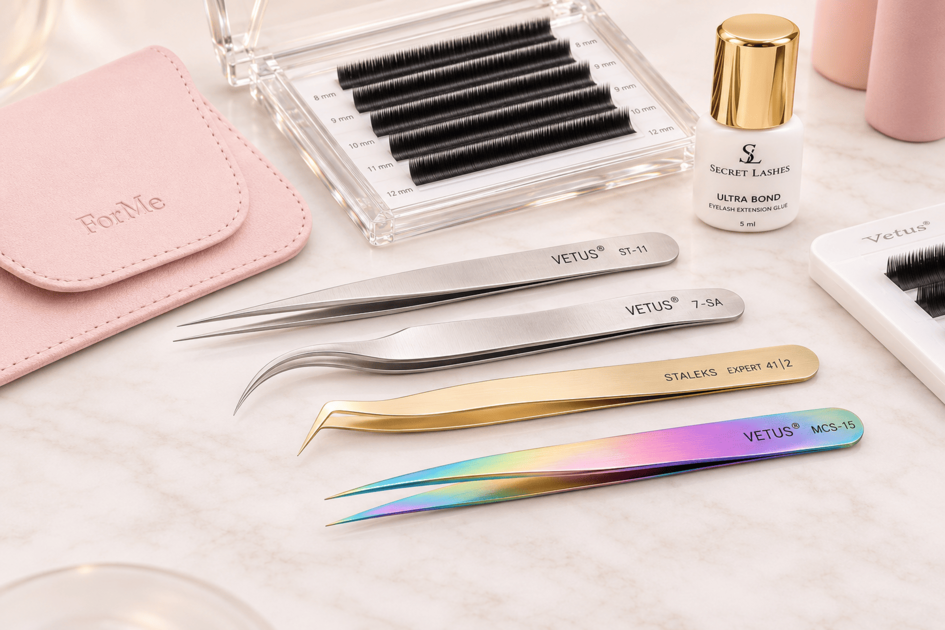
Choose lash tweezers according to the task. Straight tweezers isolate a natural lash, curved or swan-shaped tweezers apply extensions and create fans, and corner tweezers help you work in the corners of the eye. You will therefore usually need two tweezers at once. Beyond shape, consider the steel, how well the tips close, and whether the tool is non-magnetic.
At a glance
- One hand isolates while the other applies, so you need at least two tweezers: straight and curved.
- For volume work, manufacturers recommend curved and swan-shaped tweezers, such as Secret Lashes Champions 003.
- Corner tweezers such as Vetus MSA-18, MCS-32B and MCS-25A strike a balance between straight and curved designs.
- According to Vetus, non-magnetic tweezers do not attract particles.
- Store tweezers in a case: a bent tip will no longer close correctly.
What types of eyelash tweezers are there?
Extension tweezers differ mainly in the shape of their tips. The table lists models available at VSB Store on 17 November 2026 and their intended uses according to the manufacturers.
| Shape | What they are used for | Models at VSB Store | Manufacturer's description |
|---|---|---|---|
| Straight | Isolating natural lashes, classic extensions | Vetus MCS-12 | Thin, straight tips for gripping even the finest lashes |
| Curved | Application, classic and volume extensions | Vetus MCS-15, Vetus MCS-31 | MCS-15: for classic and volume techniques; MCS-31: thin, angled tips for picking up individual lashes |
| Corner tweezers | Eye corners, including inner corners | Vetus MSA-18, Vetus MCS-32B, Vetus MCS-25A | A compromise between straight and curved tweezers; MCS-25A is suitable for classic and volume work |
| Swan-shaped | Creating fans, from classic to mega volume | Secret Lashes Champions 003 | Length 11.1 cm, weight 15.9 g; for experienced lash artists and volume work |
The range also includes Vetus 5A-SA and Vetus 5B-SA. The manufacturer describes 5B-SA as made of stainless steel resistant to acids and magnets. All models can be found in the lash tweezers category.
Straight or curved: which for isolation and which for application?
Use straight tweezers for isolation and curved tweezers for application. A straight tip slips between natural lashes and moves neighboring hairs aside so the extension is attached to only one natural lash. A curved tip lets you pick up a lash from the strip at an angle and place it without blocking your view. If you have difficulty reaching short lashes in the corners, add corner tweezers rather than a third straight pair.
Which tweezers should you choose for volume extensions?
For volume extensions, choose curved or swan-shaped tweezers. Secret Lashes says Champions 003 has the flexibility to grip lashes of different thicknesses, from classic to mega volume, while the swan shape gives greater control over fine fibers. Vetus recommends MCS-15 and MCS-25A for both classic and volume techniques, so they are suitable when moving from 1:1 to fans. Volume work also requires fine lashes: compare types and thicknesses in Best Eyelash Extension Brands.
What matters besides the tip shape?
- Tip closure. Squeeze the tweezers and hold them up to the light: the tips should meet along the entire working edge, with no gap. A gap allows fine lashes to slip out.
- Steel and coating. Vetus describes MCS tweezers as hand-sharpened, made from medical-grade steel with anti-reflective and anti-corrosion coatings.
- Non-magnetic properties. According to Vetus, MCS tweezers are non-magnetic and do not attract particles.
- Weight and length. During hours of volume work, comfort in the hand matters. Champions 003 measures 11.1 cm and weighs 15.9 g; compare it with your current tweezers.
- Flexibility. The tweezers should close with light pressure. An excessively stiff tool tires the hand more quickly.
How do you care for lash tweezers?
Disinfect the tweezers before first use, as recommended by the makers of Champions 003 and Vetus 5B-SA. After each treatment, clean the tips and keep the tool in a case, such as the ForMe eyelash extension tool case. Do not drop the tweezers: Champions warns that even the best material can be damaged by a fall. You can find sterilization equipment in the sterilizers category; first check which sterilization method the tweezer manufacturer allows.
Frequently asked questions
Which eyelash tweezers are best?
The best tweezers fit your technique and close properly. To start, a set of straight tweezers for isolation, such as Vetus MCS-12, and curved ones for application, such as Vetus MCS-15, is enough. Add swan-shaped tweezers for volume work.
How many tweezers does a beginner lash artist need?
Two: straight for isolation and curved for application. Buy a third pair for corners or volume once you know which technique you use most. Two good tweezers are better than five that do not close properly.
How are lash tweezers different from eyebrow tweezers?
Eyebrow tweezers have wider, usually slanted tips for plucking hairs. Lash tweezers have fine, sharp tips for picking up individual artificial lashes and are not suitable for eyebrow shaping. Read more in How to Choose the Perfect Eyebrow Tweezers.
Are Vetus tweezers suitable for beginners?
Yes, if you want all the shapes you need from one brand: at VSB Store, Vetus offers straight, curved and corner tweezers. Learn more in the Vetus Tweezers Overview.
Author: VSB Store Editorial Team. Model descriptions are based on product pages and information from Vetus and Secret Lashes. Availability as of 17 November 2026.